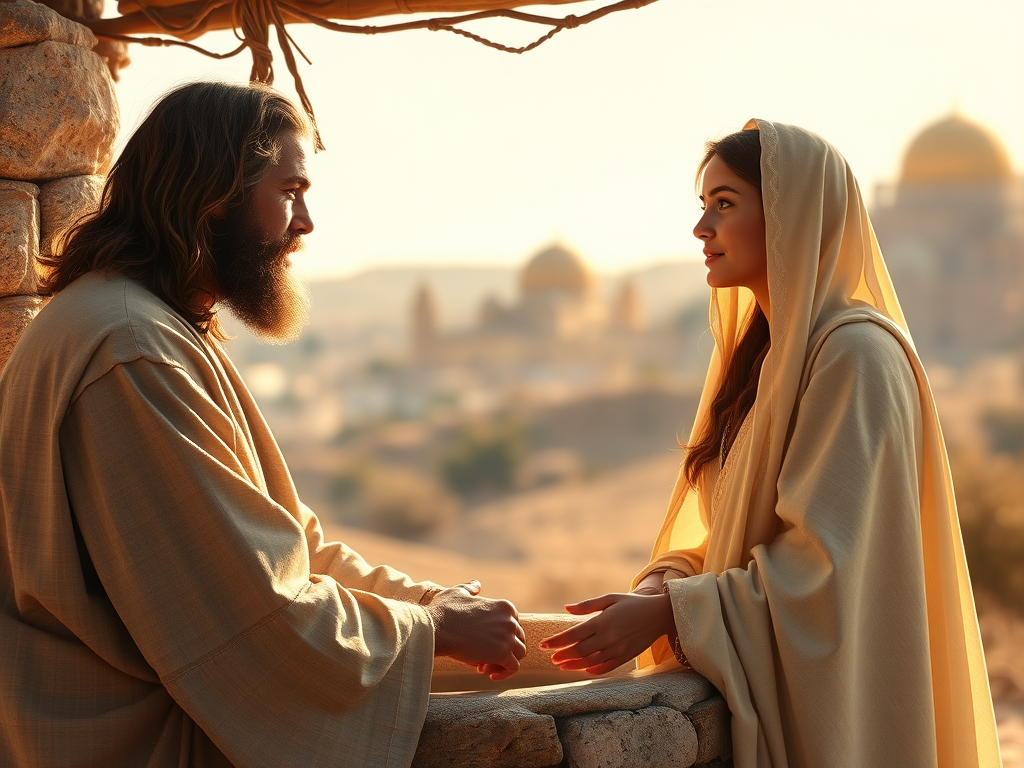
What does it mean to worship in spirit and truth in John 4:24? In Jesus’ conversation with the Samaritan woman at the well, He redefines worship in a way that goes far beyond buildings, traditions, or music styles. Understanding the context of John 4 helps reveal what Jesus actually meant when He said true worshipers must worship the Father in spirit and truth.
“God is spirit, and those who worship Him must worship in spirit and truth” (John 4:24).
This verse gets quoted constantly — in worship services, in theology books, in debates about music styles. But most of the time, people use it to defend whatever kind of worship they already prefer.
The contemporary church says “in spirit” means emotional freedom. The traditional church says “in truth” means doctrinal precision.
And both miss what Jesus was actually saying, because they’ve pulled the verse out of one of the most remarkable conversations in the Bible.
The Conversation Behind John 4:24
Jesus is talking to a Samaritan woman at Jacob’s well. They’ve moved through several layers of conversation — water, her past, His identity — and then she tries to change the subject by bringing up the old worship debate:
“Our fathers worshiped in this mountain, and you people say that in Jerusalem is the place where men ought to worship” (John 4:20).
This was the central religious argument between Jews and Samaritans for centuries.
The Samaritans built their own temple on Mount Gerizim. The Jews insisted the only legitimate place to worship God was the temple in Jerusalem. It was a dispute about location, legitimacy, and who had the “right” worship.
Some people think the woman was deflecting — dodging the uncomfortable conversation about her personal life by raising a theological controversy. Maybe.
But Jesus took the question seriously and gave her one of the most revolutionary answers in the Gospels.
Location Is No Longer the Point
“Woman, believe Me, an hour is coming when neither in this mountain nor in Jerusalem will you worship the Father” (John 4:21).
Read that carefully.
Jesus is telling a Samaritan that her mountain doesn’t matter — and telling the Jewish position that Jerusalem doesn’t matter either.
Both sides of the centuries-old debate are about to become irrelevant.
This is radical.
The temple in Jerusalem was the center of Jewish worship. God’s presence dwelled there — in the Holy of Holies, behind the curtain, where only the high priest could enter once a year. The entire sacrificial system, the priesthood, and the rhythm of Jewish life revolved around that building.
And Jesus says an hour is coming when none of that will define worship anymore.
Because worship is about to be redefined.
What “Worship in Spirit and Truth” Actually Means
“But an hour is coming, and now is, when the true worshipers will worship the Father in spirit and truth” (John 4:23).
Two words.
Spirit and truth.
Both matter. Both are required.
Worship in spirit doesn’t mean emotionally intense. It means engaging with God at the deepest level of your being — your spirit — not just your body showing up to a building.
It means the inner reality matching the outward act.
You can sing every lyric, raise your hands, weep at the altar, and still not be worshiping in spirit if your heart is somewhere else entirely.
Worship in truth doesn’t simply mean having the right theology (though theology matters). It means worshiping God as He actually is, not as you’ve imagined Him to be.
Your worship must be grounded in the reality of who God has revealed Himself to be in Scripture — not in preferences, traditions, or emotional states.
Spirit without truth becomes sentimentality.
Truth without spirit becomes dead orthodoxy.
Jesus demands both — a fully engaged heart meeting the fully revealed God.
What Most People Miss in John 4
There’s a phrase tucked into verse 23 that’s easy to miss:
“For such people the Father seeks to be His worshipers.”
God is seeking.
The Father actively looks for people who will worship Him this way.
The Creator of the universe isn’t passively waiting for proper worship to show up. He is pursuing worshipers.
And notice who He said it to.
A Samaritan woman with a messy past. Standing at a well. In enemy territory. In the middle of the day.
He didn’t deliver this teaching in the temple courts to an audience of priests.
He revealed the future of all worship to an outsider.
Because true worship was never about your location, your tradition, your credentials, or your background.
It’s about spirit and truth.
Why This Changes How You Worship
If worship is spirit and truth — not building and tradition — then it isn’t limited to Sunday morning.
You can worship at your kitchen table at 6 AM.
You can worship in your car on the commute.
You can worship sitting on the floor of your kids’ room after they’ve fallen asleep.
But it also means you can sit in a pew every Sunday and not worship at all.
Location doesn’t guarantee connection.
Emotion doesn’t guarantee truth.
The real question Jesus raises in John 4:24 isn’t:
“Where do you worship?”
It’s:
“Do you worship?”
Are you engaging with God in the deepest part of who you are, according to the truth of who He is?
Or are you simply showing up to a building and going through familiar motions?
The Father is seeking.
That should change how you approach Him — wherever you happen to be standing.
Watch the Deep Dive
This passage is part of the longest recorded conversation Jesus has with any individual in the Gospels, and every verse matters.
I did a full deep-dive video walking through John chapters 4 through 6 on YouTube.
If this post made you want to go deeper, watch it here:
youtube.com/@BibleBytes24
And subscribe so you don’t miss the John 7–9 deep dive
Leave a Reply