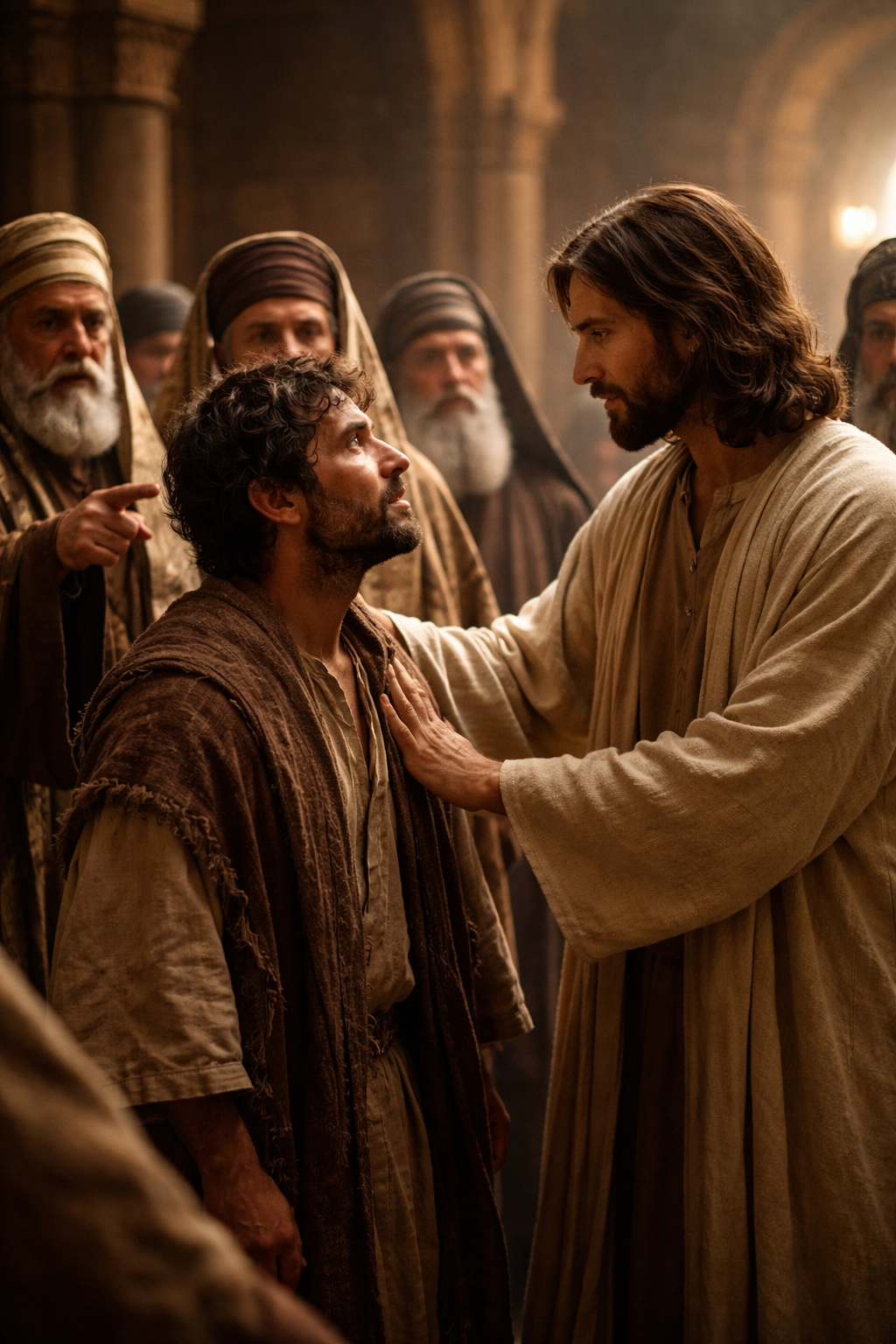
Pharisees Blindness Explained: Why They Were More Blind Than the Blind Man (John 9)
Why were the Pharisees spiritually blind in John 9, even after witnessing a miracle? This chapter reveals one of the sharpest ironies in Scripture — and what it means for us today.
John chapter 9 contains one of the sharpest ironies in the entire Bible — and most people read right past it.
A man born blind receives his sight for the first time in his life. The religious leaders who have had perfect vision since birth are exposed as the truly blind ones. And by the end of the chapter, the roles have completely reversed: the outsider is worshiping Jesus, and the insiders are condemned by their own claim to see.
How did it get there?
The Investigation That Backfired
After Jesus healed the man, the Pharisees didn’t celebrate. They investigated. Their problem wasn’t with the healing — it was with the timing. “This man is not from God, because He does not keep the Sabbath” (John 9:16). Their theological system had already reached its verdict: anyone who heals on the Sabbath is a sinner. The evidence was irrelevant.
But not all of them agreed. Others said, “How can a man who is a sinner perform such signs?” (9:16). A division formed. And rather than wrestle with the implications, the majority doubled down. They interrogated the man. They interrogated his parents. They called him back for a second round.
His parents, terrified of being expelled from the synagogue, refused to vouch for what had happened: “He is of age, ask him” (9:23). Social pressure silenced them. The cost of associating with Jesus was already real.
The Man’s Testimony Gets Bolder
Here’s what’s remarkable about the formerly blind man: he doesn’t back down. With each interrogation, his understanding deepens and his courage grows.
Round one: “He is a prophet” (9:17).
Round two: “Whether He is a sinner, I do not know; one thing I do know, that though I was blind, now I see” (9:25). This is one of the most powerful sentences in the Bible. He couldn’t debate their theology. He couldn’t match their credentials. But he had something they couldn’t argue with: personal experience of what Jesus had done.
Round three: “Since the beginning of time it has never been heard that anyone opened the eyes of a person born blind. If this man were not from God, He could do nothing” (9:32-33). Now he’s teaching them. A former beggar is giving the Sanhedrin a theology lesson.
They threw him out. “You were born entirely in sins, and are you teaching us?” (9:34). Their response tells you everything. When the evidence contradicts the system, the system protects itself by removing the evidence.
The Reversal in John 9
After the man was expelled, Jesus found him and revealed His identity: “You have both seen Him, and He is the one who is talking with you” (9:37). The man believed and worshiped.
Then Jesus spoke directly to the Pharisees who were present: “If you were blind, you would have no sin; but since you say, ‘We see,’ your sin remains” (9:41).
This is the knife.
The Pharisees’ problem wasn’t ignorance — it was certainty. If they’d admitted they couldn’t see, they could have been healed. But they insisted they already had sight. And that insistence made them unreachable.
The most dangerous spiritual condition isn’t blindness.
It’s blindness that thinks it can see.
The Application That Stings
It’s easy to read John 9 and put yourself in the healed man’s shoes. But the uncomfortable question is whether we’re more like the Pharisees than we want to admit.
Have you ever dismissed something God might be doing because it didn’t fit your expectations? Have you ever prioritized your theological system over someone’s actual experience of Jesus? Have you ever looked at evidence of God working in an unexpected way and said “that can’t be right” because it violated your categories?
The Pharisees weren’t stupid. They weren’t evil in some cartoonish way. They were deeply committed to their understanding of God — and their commitment to their understanding became the thing that blinded them to God standing right in front of them.
John 9 asks us to hold our theology loosely enough that when Jesus shows up doing something unexpected, we don’t throw Him out to protect our system.
Going Deeper in John 9
The light and darkness theme that runs through John 9 started all the way back in John 1:5. If you want to trace it from the beginning — from “the Light shines in the darkness” through the blind man’s healing — my study guide Encountering Jesus: A Deep Dive into John 1–3 lays the foundation for everything John builds in the later chapters.
Grab it at:
Leave a Reply