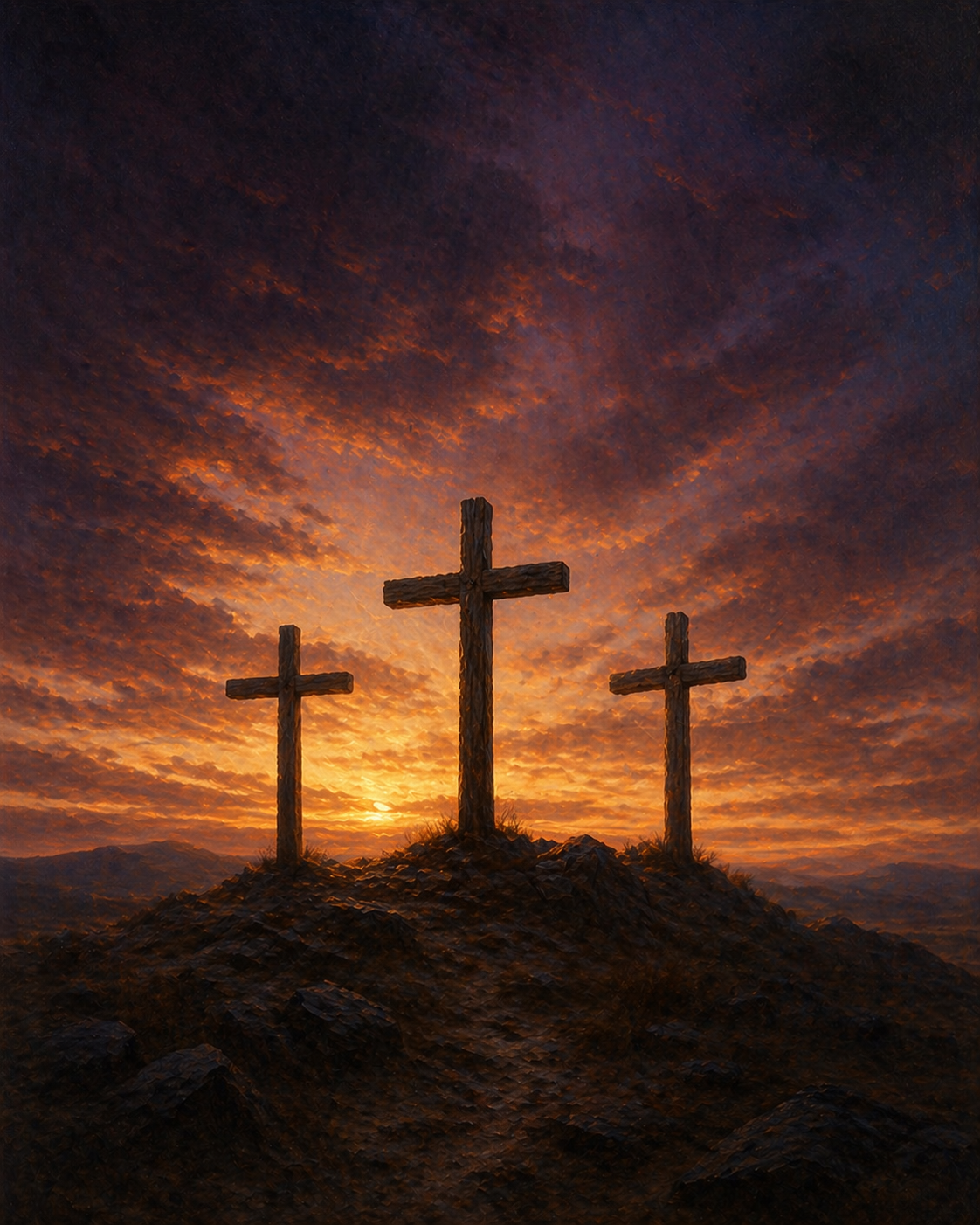
The last words a person speaks carry weight. They are chosen — consciously or not — as a final statement about what mattered most.
Jesus’s final word from the cross was one word in Greek. And it changed everything.
The Setup John Wants You to See
John is the most deliberate writer in the New Testament. He does not include details by accident. So when he narrates the crucifixion, every element is placed with purpose.
“After this, Jesus, knowing that all things had already been accomplished, to fulfill the Scripture, said, ‘I am thirsty’” (John 19:28).
Notice: Jesus knew all things had been accomplished. His thirst was not a cry of desperation. It was a deliberate act to fulfill Scripture — Psalm 69:21 speaks of being given vinegar to drink. Even on the cross, Jesus was in control of the script. He was not a victim of circumstances. He was the author of the story, writing the final chapter in His own blood.
They put a sponge full of sour wine on a branch of hyssop and brought it to His mouth (John 19:29). Hyssop. The same plant used to apply the blood of the Passover lamb to the doorposts in Exodus 12. John wants you to see it: the Lamb of God — the one John the Baptist identified in chapter 1:29 — is completing the Passover sacrifice that every lamb in Israel’s history had been pointing toward.
The Word
“Therefore when Jesus had received the sour wine, He said, ‘It is finished!’ And He bowed His head and gave up His spirit” (John 19:30).
In English, “it is finished” sounds like defeat. Like a man saying “I am done” because he has nothing left. But the Greek word is tetelestai — and it means the exact opposite of defeat.
Tetelestai comes from the root teleo, which means to bring to completion, to accomplish fully, to reach the intended goal. It was used in several specific contexts in the ancient world that would have been immediately understood by John’s readers.
In accounting, tetelestai was stamped on receipts and invoices. It meant “paid in full.” The debt is settled. Nothing more is owed. When Jesus said tetelestai, He was declaring that the debt of human sin — every transgression, past, present, and future — had been paid. Completely. Finally. The invoice is stamped. The account is closed.
In art, tetelestai was used when a painter or sculptor completed a masterpiece. It meant “it is finished” in the sense of “it is perfected.” The work has reached its intended form. Nothing needs to be added. When Jesus said tetelestai, He was declaring that the work of redemption — planned before the foundation of the world — had reached its perfect, completed form. Nothing you can add to it will improve it. Nothing you fail to do will diminish it.
In servanthood, tetelestai was what a servant said when reporting back to a master after completing an assignment. “The task you gave me is done.” When Jesus said tetelestai, He was reporting to the Father: the mission You sent Me to accomplish is complete. I did what I came to do.
He Gave Up His Spirit
John’s phrasing is precise: Jesus “gave up” His spirit. Not “His spirit left Him.” Not “He died.” He gave it up. Voluntarily. On His own initiative. He had said this would happen back in chapter 10: “No one has taken it away from Me, but I lay it down on My own initiative. I have authority to lay it down, and I have authority to take it up again” (John 10:18).
The Roman soldiers did not take His life. The nails did not kill Him. He dismissed His spirit when the work was finished — not a moment before.
The Blood and Water
A soldier pierced His side with a spear, “and immediately blood and water came out” (John 19:34). John emphasizes that he personally witnessed this and that his testimony is true (John 19:35). Why does this detail matter enough for John to stake his credibility on it?
Medically, the flow of blood and water likely indicates that the pericardial sac around the heart had been pierced — confirming that Jesus was genuinely, physically dead. This was not a swoon. This was not a near-death experience. Jesus died. His heart stopped. The water and blood proved it.
Theologically, John may be pointing to cleansing and atonement — water for purification, blood for sacrifice. The two elements that run through the entire Old Testament sacrificial system flowing from the side of the final sacrifice.
The Burial
Joseph of Arimathea — a secret disciple who had been afraid of the Jewish leaders — asked Pilate for the body (John 19:38). And Nicodemus came too. The same Nicodemus who came to Jesus at night in chapter 3. He brought seventy-five pounds of burial spices — an extravagant, public, unmistakable act.
The man who started in the dark ended at the cross in broad daylight. His journey from John 3 to John 19 is one of the most beautiful arcs in the entire Gospel. Fear became faith. Secrecy became sacrifice. And it happened at the foot of the cross where the work was finished.
What This Means for You
Tetelestai means you cannot add to what Jesus accomplished. You cannot supplement the cross with your performance. You cannot finish what He already declared complete.
If you have been carrying guilt that Jesus already paid for, hear the word: tetelestai. If you have been trying to earn what was already given as a gift, hear the word: tetelestai. If you have been afraid that your sin is bigger than His sacrifice, hear the word: paid in full.
The invoice is stamped. The masterpiece is complete. The mission is accomplished.
It is finished. And He meant it.