Did Jesus really feed the 5,000? John 6 reveals why this miracle is called a sign—and how many people missed what it was pointing to.
The feeding of the 5,000 is the only miracle—aside from the resurrection—that appears in all four Gospels. That fact alone tells you how important this moment was to the early church. But if all you take away from the story is “Jesus made a lot of food appear,” you’ve barely scratched the surface of what John is showing us in John 6.
John doesn’t even call this event a miracle. He calls it a sign. And signs are never the destination. They point beyond themselves. The real question isn’t whether Jesus fed a massive crowd—it’s what that feeding was meant to reveal about who He is.
The Feeding of the 5,000 in John 6: The Setup That Changes Everything
John 6 opens with a massive crowd following Jesus because they had seen Him healing the sick. Jesus goes up on a mountain with His disciples and watches the people coming toward Him. Then He turns to Philip and asks a question He already knows the answer to:
“Where are we to buy bread, so that these may eat?” (John 6:5)
John immediately explains what’s happening: Jesus is testing Philip. He already knows what He’s going to do (John 6:6). This isn’t a logistical crisis. It’s a deliberate teaching moment. Jesus is inviting His disciples to confront the limits of their own calculations.
Philip does what most of us would do. He runs the numbers. Two hundred denarii—roughly eight months’ wages—wouldn’t be enough for everyone to even get a little. The math doesn’t work. When the problem is viewed strictly through human resources, scarcity always wins.
The Boy with Five Loaves and Two Fish
Then Andrew speaks up:
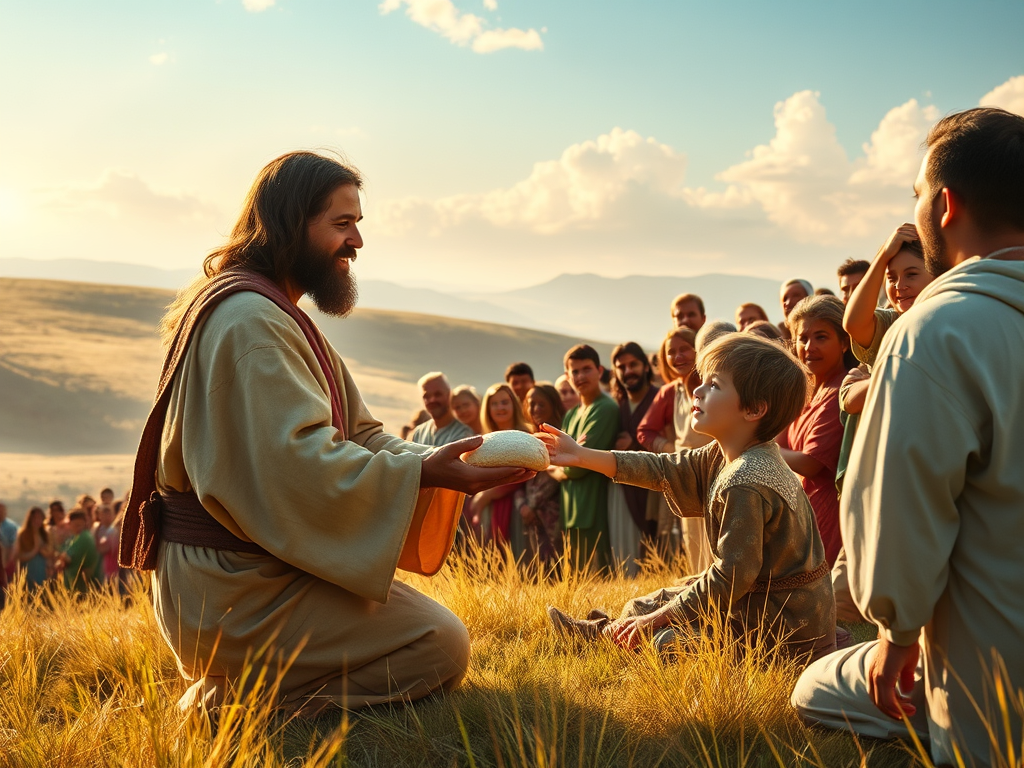
“There is a lad here who has five barley loaves and two fish, but what are these for so many people?” (John 6:9)
Barley loaves matter. This is peasant food—the cheapest bread available. This isn’t a wealthy family’s picnic. It’s a poor child’s lunch. Andrew brings it to Jesus while openly admitting that it isn’t enough. He doesn’t understand how it will work. He simply knows who to bring it to.
And there’s a detail here that’s easy to miss. Someone packed that lunch. A parent wrapped up five barley loaves and two fish that morning, completely unaware that this ordinary act of provision would become the starting point for one of the most famous moments in the Gospels. The feeding of the 5,000 begins with faithfulness that looks painfully small.
What the Feeding of the 5,000 Really Points To
Jesus takes the loaves, gives thanks, and distributes them. Everyone eats. Everyone is satisfied. And twelve baskets of leftovers are gathered—one for each disciple, as if Jesus is making sure the lesson lands.
The crowd’s reaction is revealing:
“This is truly the Prophet who is to come into the world.” (John 6:14)
They recognize the pattern. Moses. Manna. Bread in the wilderness. This looks like the prophet promised in Deuteronomy 18:15. But they stop short of the truth. They want a king who provides bread, not a Savior who provides life. So they try to make Jesus king by force.
Jesus refuses—and withdraws to the mountain alone.
This is the turning point of the chapter. The crowd wants what Jesus can give. Jesus wants to give Himself. The sign points to the Bread of Life, but the crowd settles for full stomachs instead of transformed hearts.
Why the Crowd Missed the Sign in John 6
The next day, the crowd tracks Jesus down across the sea. He confronts them directly:
“You seek Me, not because you saw signs, but because you ate of the loaves and were filled.” (John 6:26)
This isn’t a rebuke aimed at skeptics or enemies. It’s aimed at followers. People who showed up. People who stayed close. People who benefited. The question John 6 forces into the open is uncomfortable: Why are you following Jesus?
If the bread stops—if the prayers aren’t answered the way you hoped, if obedience becomes costly, if following Jesus no longer feels rewarding—do you still want Him? Or were you really after the loaves all along?
The Choice John 6 Leaves Us With
John chapter 6 doesn’t end with celebration. It ends with division. Many disciples walk away. Only the twelve remain. The feeding of the 5,000 isn’t just about abundance—it’s about exposure. It reveals what kind of king people want, and what kind of Savior Jesus actually is.
If you want to explore this chapter further, the feeding of the 5,000 launches one of the most intense sections in John’s Gospel—from the miracle, to the sea crossing, to the Bread of Life discourse, to the moment where allegiance has a cost. My study guide The Teacher Who Transforms: A Deep Dive into John 4–6 walks through John 6 verse by verse, including the language behind Jesus’ hardest statements and what they reveal about real discipleship.
Leave a Reply