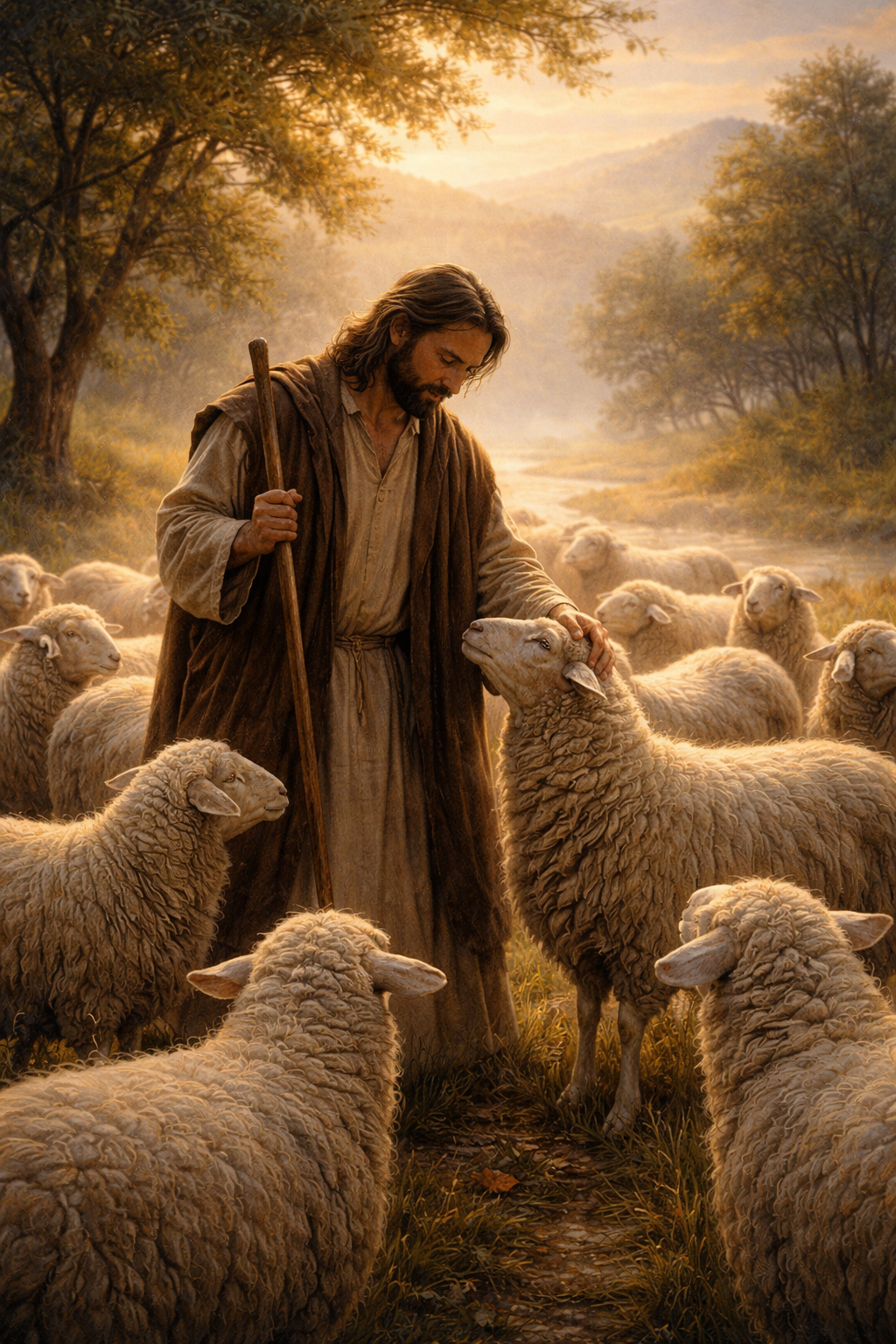
The Promise of Eternal Security in John 10
Few passages in the Bible offer more comfort — or spark more debate — than these two verses. Jesus says something so absolute, so final, that it either puts your soul at rest or makes you argue with it.
“My sheep hear My voice, and I know them, and they follow Me; and I give eternal life to them, and they will never perish; and no one will snatch them out of My hand” (John 10:27-28).
Five claims in two verses. Each one matters. And together they form one of the strongest promises of security anywhere in Scripture.
Claim 1: My Sheep Hear My Voice
This is not about audible hearing. The Greek word akouo carries the idea of listening with understanding and response — the way a child recognizes their parent’s voice in a crowded room. Jesus is describing a relationship, not an event. His sheep know His voice because they belong to Him, and belonging produces recognition.
If you have ever been reading Scripture and a verse suddenly felt like it was written directly to you — not as information but as a personal word — that is what Jesus is describing. His sheep hear because they are His. The hearing is a result of belonging, not a prerequisite for it.
Claim 2: I Know Them
The word “know” here is ginosko — intimate, experiential knowledge. This is not God knowing facts about you the way a database stores information. This is relational knowing. Jesus compares it earlier in the chapter to how He and the Father know each other (John 10:15). He is applying the deepest relationship in the universe — the mutual knowledge of the Father and Son — to how He knows you.
You are not anonymous to Jesus. You are not a number. You are known by name, known in your mess, known in your doubt, known in the 2 AM version of yourself that nobody else sees.
Claim 3: They Follow Me
Following is the evidence, not the condition. Jesus does not say “if they follow perfectly, then I give them eternal life.” He describes a pattern — His sheep hear, they are known, and they follow. Sometimes the following is stumbling. Sometimes it is slow. Sometimes the sheep wanders and the shepherd goes after it. But the trajectory is toward Jesus, not away from Him.
Claim 4: I Give Eternal Life and They Will Never Perish
Two things to notice. First — “I give.” Eternal life is a gift. Not a wage, not a reward, not a payment for services rendered.
Second — “they will never perish.” The Greek here is emphatic. It is a double negative — ou me — the strongest way to deny something in the Greek language. It is not “they probably won’t perish.” It is “they will absolutely, categorically, under no circumstances perish.” Jesus could not have said it more forcefully.
Claim 5: No One Will Snatch Them Out of My Hand
Then He adds a second layer: “My Father, who has given them to Me, is greater than all; and no one is able to snatch them out of the Father’s hand” (John 10:29).
Two hands. The sheep are in Jesus’s hand. The Father’s hand is around that. Double grip. And the promise is not “no one will try” — it is “no one is able.” Not angels, not demons, not your worst day, not your biggest failure. No one has the power to remove you from His grip.
This does not mean Christians will not struggle, doubt, or wander. Peter denied Jesus three times and was still a sheep. The promise is not that following will be easy. The promise is that the Shepherd’s grip does not depend on yours.