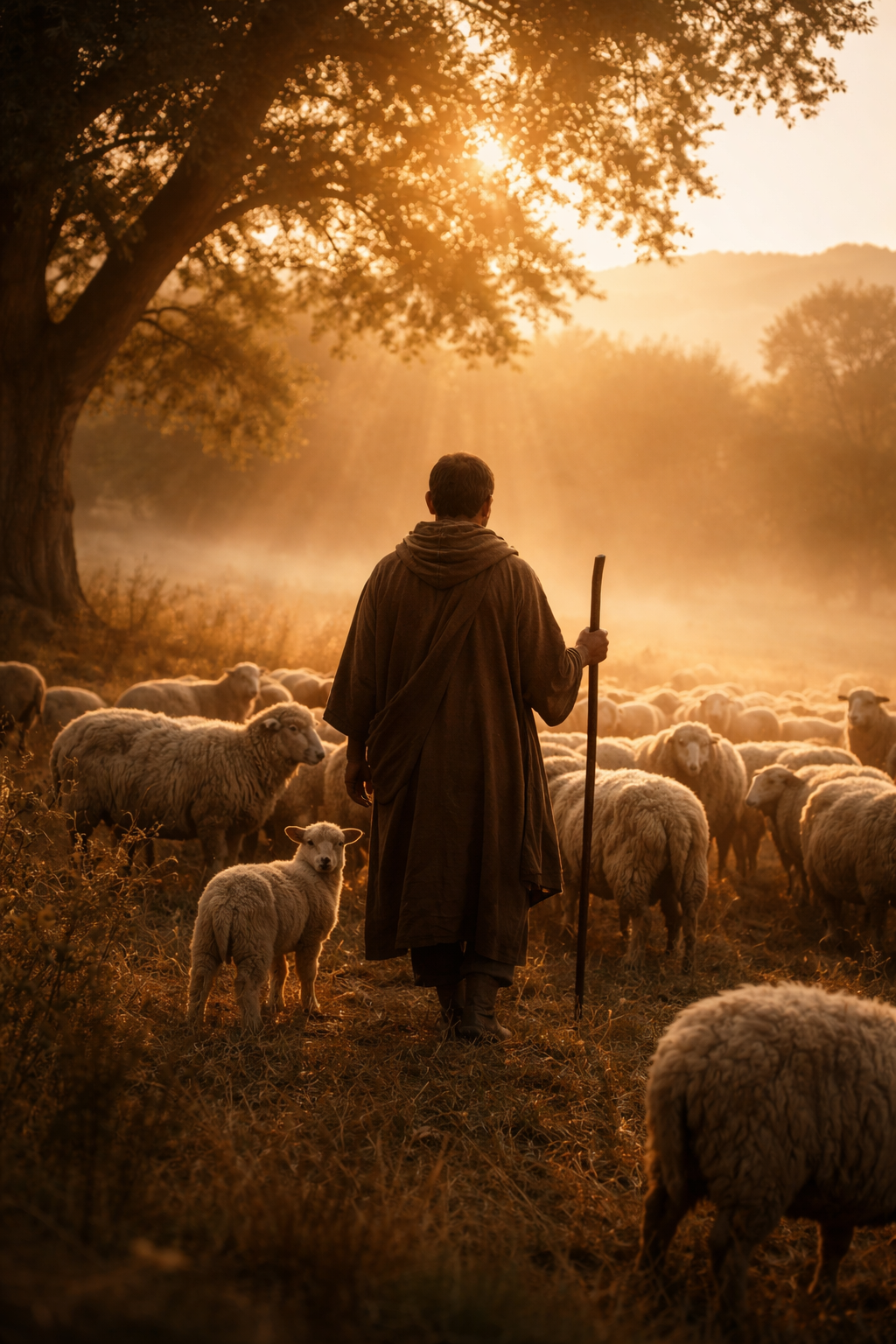
I Am the Good Shepherd Meaning: John 10 Explained
In first-century Palestine, shepherds were not romantic figures. They were among the lowest social classes — dirty, uneducated, considered unreliable as legal witnesses, and ritually unclean because of constant contact with animals. When Jesus said “I am the Good Shepherd,” He wasn’t choosing a prestigious metaphor. He was choosing the one nobody respected.
And that choice reveals something essential about who He is.
The Context: Coming Off John 9
Jesus makes the Good Shepherd declaration immediately after the man born blind was thrown out of the synagogue by the Pharisees. The connection is deliberate. The religious leaders — the people who were supposed to shepherd Israel — had just expelled a man for receiving his sight from God. They were bad shepherds. Hired hands. And Jesus is about to draw the contrast.
This echoes Ezekiel 34, where God condemned Israel’s leaders as negligent shepherds who fed themselves instead of the flock, failed to strengthen the weak, and scattered the sheep. God’s promise in Ezekiel was: “I Myself will search for My sheep and look after them… I will place over them one shepherd, My servant David” (Ezekiel 34:11, 23).
When Jesus says “I am the Good Shepherd,” every Jewish listener who knew their prophets would have heard the echo. God promised He would come Himself. And here He is.
What Makes the Good Shepherd Different
Jesus distinguishes Himself from every other leader in two ways.
First, He knows His sheep: “I am the good shepherd, and I know My own and My own know Me, even as the Father knows Me and I know the Father” (John 10:14-15). The verb “know” here — ginosko — means intimate, experiential knowledge. Jesus compares His knowledge of His people to the mutual knowledge between Himself and the Father. That’s not general awareness. That’s the deepest possible relational knowing applied to you personally.
Second, He dies for His sheep: “The good shepherd lays down His life for the sheep” (John 10:11). A hired hand runs when the wolf comes because the sheep aren’t his. He has no stake. But Jesus doesn’t just risk His life — He lays it down. Willingly. By choice. “No one has taken it away from Me, but I lay it down on My own initiative” (John 10:18).
The cross wasn’t something that happened to Jesus. It was something He chose. For you. By name.
The Promise of the Good Shepherd
Then comes one of the most debated — and one of the most comforting — passages in the New Testament:
“My sheep hear My voice, and I know them, and they follow Me; and I give eternal life to them, and they will never perish; and no one will snatch them out of My hand. My Father, who has given them to Me, is greater than all; and no one is able to snatch them out of the Father’s hand” (John 10:27-29).
Double security. The sheep are in Jesus’s hand, and the Father’s hand is around that. Two hands. Two grips. And the promise: no one will snatch them out. Not “you might fall out.” Not “if you try hard enough, you’ll stay in.” No one — no force, no failure, no enemy, no demon — has the power to remove you from His grip.
This doesn’t mean Christians won’t struggle, doubt, or wander. It means the Shepherd goes after them when they do. And His hand doesn’t let go.
“I and the Father Are One”
The chapter builds to a climax that nearly gets Jesus killed. When the Jews press Him: “If You are the Christ, tell us plainly” (10:24), He says it as plainly as possible: “I and the Father are one” (10:30).
They picked up stones. They understood exactly what He claimed. Not agreement with the Father. Not alignment with the Father. Unity. Oneness. The same essence. The shepherd standing in front of them was God.