What does the story of the woman caught in adultery in John 8 really mean? This powerful moment reveals how Jesus handles sin, shame, and justice — but it’s also one of the most misunderstood passages in the Gospels.
It might be the most dramatic scene in the Gospels.
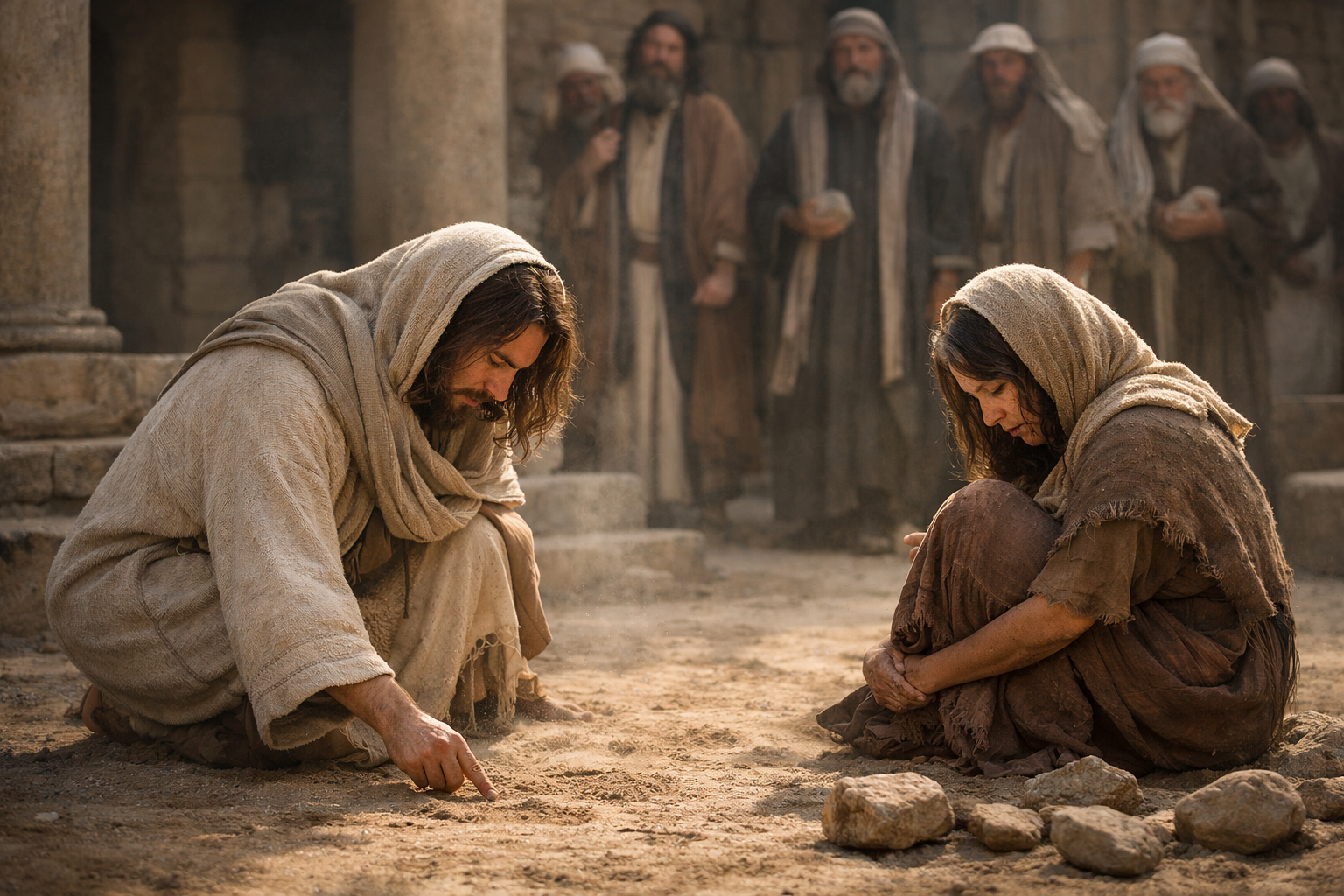
A woman caught in the act of adultery is dragged before Jesus by the scribes and Pharisees. They quote the Law of Moses. They demand a verdict. And Jesus bends down and writes in the dirt.
“He who is without sin among you, let him be the first to throw a stone at her” (John 8:7).
One by one, they leave — starting with the oldest.
And Jesus looks at the woman and says:
“I do not condemn you, either. Go. From now on sin no more” (John 8:11).
It’s a beautiful story.
It’s also almost universally misunderstood.
What the Pharisees Were Really Doing
This wasn’t about justice.
It was a trap.
John tells you directly:
“They were saying this, testing Him, so that they might have grounds for accusing Him” (John 8:6).
The Law of Moses prescribed death for adultery (Leviticus 20:10, Deuteronomy 22:22).
But Roman law complicated things — Jewish leaders did not have full authority to carry out executions (John 18:31).
So they created a dilemma:
- If Jesus said “stone her,” He could be reported to Rome
- If He said “release her,” He could be accused of rejecting the Law
Either way, they thought they would win.
But their goal wasn’t justice.
It was to destroy Jesus.
And there’s another detail that exposes the setup:
Where is the man?
Adultery requires two people. The Law required both to be judged. The absence of the man shows this wasn’t a fair trial — it was a staged accusation.
What Did Jesus Write in the Dirt?
John tells us:
“Jesus bent down and began to write on the ground” (John 8:6).
But he never tells us what Jesus wrote.
That silence has led to many theories:
- He wrote the sins of the accusers
- He referenced Jeremiah 17:13
- He paused to break the mob mentality
We don’t know for certain.
But we do know what happened next.
Jesus stood up and said one sentence that ended everything:
“He who is without sin among you, let him be the first to throw a stone.”
No debate.
No argument.
Just a mirror held up to every person standing there.
Grace and Truth in Jesus’ Response
When everyone leaves, only two people remain:
Jesus and the woman.
And His words are one of the clearest pictures of grace and truth in all of Scripture:
“I do not condemn you, either. Go. From now on sin no more.”
Two things are happening at the same time.
1. No Condemnation (Grace)
Jesus is the only one without sin.
The only one with the right to judge.
And He chooses not to condemn her.
2. A Call to Change (Truth)
Jesus doesn’t ignore the sin.
He doesn’t excuse it.
He calls her to a different way of living:
“Sin no more.”
Grace without truth would ignore the problem.
Truth without grace would crush the person.
Jesus does neither.
He holds both — completely and perfectly.
What Most People Get Wrong About John 8
This story is often misunderstood in two opposite ways.
Misunderstanding #1: “Don’t Judge Anything”
Some people use this passage to argue that no one should ever call sin what it is.
But Jesus didn’t say sin doesn’t matter.
He said:
“Sin no more.”
Misunderstanding #2: “Grace Must Be Earned”
Others believe Jesus forgave her only because she would change.
But the order matters.
He gave no condemnation first.
Then came the call to transformation.
Grace came before change — not because of it.
What This Means for Us Today
Jesus didn’t tolerate sin.
And He didn’t weaponize holiness.
He held the standard and the person at the same time.
That’s the model for anyone who follows Him.
A Resource for Hard Seasons
If you feel more like the woman in the circle than the people standing around her — if shame feels louder than grace — I made something for that.
QuickStudy Vol. 1: Hope & Healing walks through 20 verses focused on:
- feeling forgotten
- feeling weak
- feeling afraid
- remembering your identity in Christ
Each passage includes context, original language, and a reflection question.
You can find it here:
https://biblebytes24.gumroad.com/l/QuickStudyV1
Final Thought
If this helped you understand John 8 more clearly, consider sharing it with someone who needs to be reminded of both grace and truth.