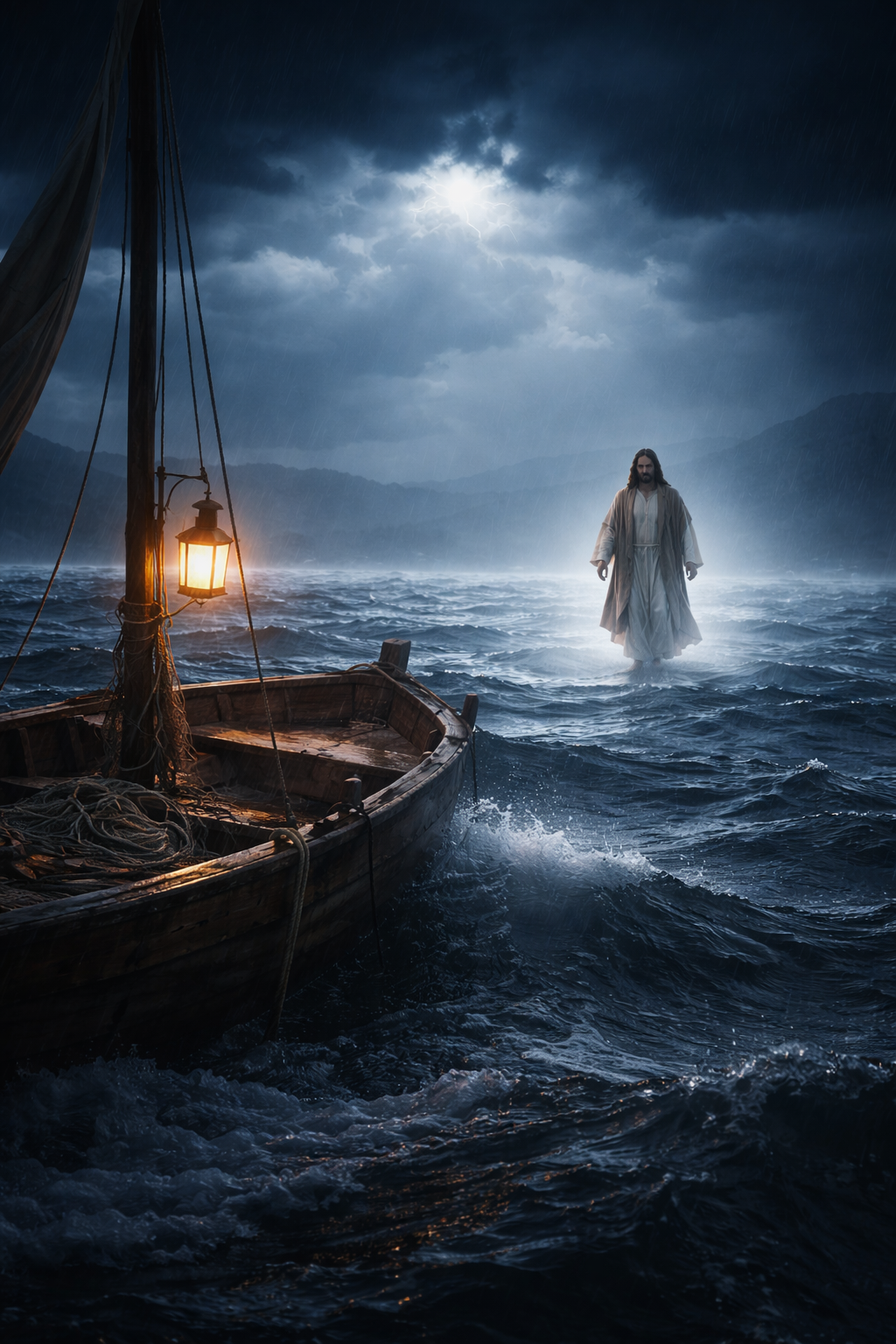
What does Jesus walking on water in John 6 actually mean? In the Gospel of John’s account we find a moment that’s less about a dramatic rescue stunt and more about divine identity meeting human fear — and that changes everything. Gospel of John
The scene is vivid: the crowd has just been fed, the disciples are in a boat, a storm whips up, and someone walks toward them on the waves. But the timing, the words spoken, and the placement of the story reveal a theological message most summaries miss.
What Happened Right Before the Storm
Before the storm the crowd had witnessed a miracle of provision — thousands fed with five loaves and two fish. The people were so excited they tried to make him a political king. He refused the crown and withdrew to the mountain alone. Meanwhile the disciples rowed across the lake without him.
They were in the middle of the water when the wind rose and the sea turned violent — a common, sudden storm on the Sea of Galilee that seasoned fishermen would have feared.
(That body of water, the Sea of Galilee, sits well below sea level and is prone to sudden squalls.) Sea of Galilee
The Storm and a Terrifying Arrival
They had rowed several miles when someone began walking toward the boat on the water. The disciples weren’t merely startled — the Greek used for their fear is the same word the Gospel uses when people stand before the divine. They were confronting something that broke every natural category.
Then came two words that change the tone: “It is I; do not be afraid.” In the original language the phrase is ego eimi — “I AM.” This is the same language God used when speaking to Moses at the burning bush. Moses
When the one who walks on the waves names himself with the divine phrase, the moment becomes a revelation: the same God who met Israel in the wilderness is now approaching His people in the storm.
Jesus Reveals Who He Is (and Fear Meets Identity)
The Gospel writer doesn’t linger on prolonged action here. He compresses the story: the terror, the divine “I AM,” the acceptance, and then the boat arriving at shore. Once the disciples recognized and received Him, the journey was completed.
Jesus’ use of “I AM” is not a casual identifier. It’s theological. It solves fear not by changing circumstances first but by changing the ground of trust: the presence of the one who is the source of life, light, and rescue.
(That famous figure who spoke these words and walked on the water is the same one who declares “I am the bread of life” later in the chapter.) Jesus
Why John Places the Story Here
The placement of this episode between the feeding miracle and the “Bread of Life” teaching is purposeful. The pattern reads like this:
- Provision — the bread is given.
- Revelation — the “I AM” walks on chaos.
- Claim — the exclusive claim to be the bread of life.
John wants readers to see that the one who provides is also the one who reveals himself and calls for faith. Before the crowd must decide whether to accept Him as the bread of life, John shows us He is the divine presence who walks on chaos.
The Question Underneath: Are You Afraid — or Have You Met Him?
The disciples’ fear in the storm is understandable. But notice how fear is resolved: not by the wind stopping first nor by reaching land first, but by the revelation of identity.
This is a pattern in the Gospel: every “I AM” answer addresses a human problem — hungry? He is the bread of life. In darkness? He is the light. Lost? He is the way. Afraid? I AM.
Whatever storm you face tonight, the change you need is not necessarily better conditions. It’s the presence of the One walking toward you in the middle of it.
A Small Resource If You Need It
If anxiety or fear is loud right now and Scripture feels distant, I made a short journal-style guide called QuickStudy Vol. 1: Hope & Healing. It walks through 20 verses that address being forgotten, weak, or afraid with original language notes and practical reflection prompts. It’s short enough to read with your morning coffee at biblebytes24.gumroad.com.
Call to Action (small, natural)
If this reflection helped, consider sharing it with someone who’s in a storm tonight — and if you’d like more short Bible reflections, sign up for email updates on my site.