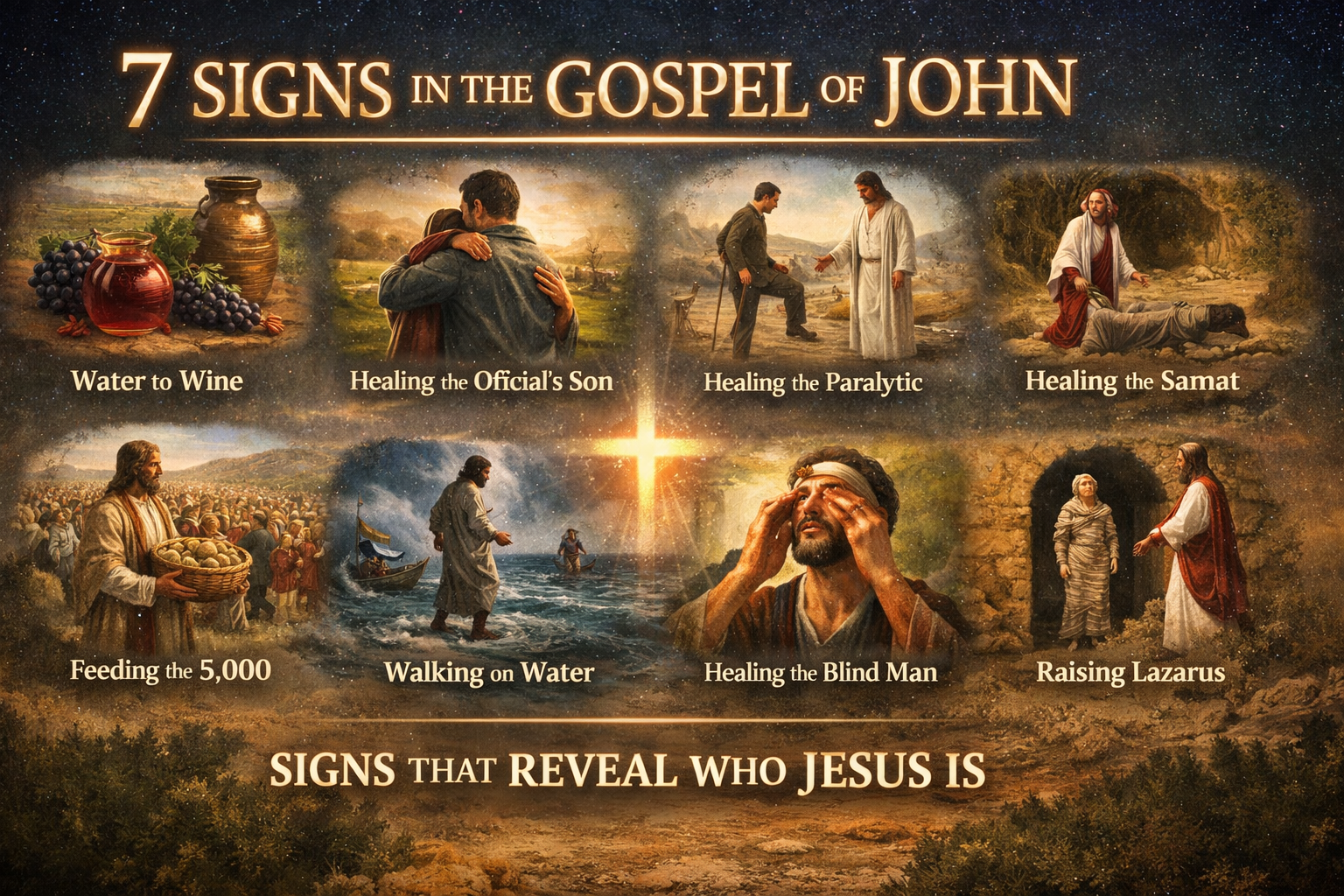
What are the 7 signs in John’s Gospel, and why do they matter? The Gospel of John is carefully structured around seven miracles — not random events, but intentional signs that reveal who Jesus is and call people to believe.
John tells us his purpose clearly:
“These have been written so that you may believe that Jesus is the Christ, the Son of God; and that believing you may have life in His name” (John 20:31).
He could have included more miracles.
He says so himself:
“There are also many other things which Jesus did…” (John 21:25).
But he chose seven.
In Scripture, seven represents completeness.
Together, these signs form a complete picture:
Jesus is exactly who He claims to be.
Sign 1: Water to Wine (John 2:1–11)
At a wedding in Cana, Jesus turned water into wine — about 150 gallons of it.
John calls this the beginning of His signs.
This sign reveals Jesus as the one who transforms the old into something new, replaces ritual with celebration, and provides in abundance.
The best wine came last — a picture that God’s work always moves toward something better.
Sign 2: Healing the Official’s Son (John 4:46–54)
A royal official’s son was dying miles away.
Jesus didn’t travel to him.
He simply said:
“Go; your son lives.”
The man believed — without seeing proof — and his son was healed at that exact moment.
This sign reveals that Jesus’ word has authority over distance and death.
It also defines real faith:
Trusting God’s word before you see the outcome.
Sign 3: Healing the Paralytic (John 5:1–9)
A man paralyzed for 38 years sat beside the Pool of Bethesda.
Jesus asked:
“Do you want to get well?”
The man hesitated.
Jesus healed him anyway.
This miracle, performed on the Sabbath, triggered major conflict with religious leaders.
It reveals Jesus as Lord over the Sabbath and shows that restoration matters more than religious systems.
Sign 4: Feeding the 5,000 (John 6:1–14)
Five loaves and two fish fed 5,000 people — with leftovers.
The crowd tried to make Jesus king.
He refused.
This sign reveals Jesus as the bread of life — the one who satisfies deeper hunger.
But it also exposes something:
Many people follow Jesus for what He provides, not for who He is.
Sign 5: Walking on Water (John 6:16–21)
In a storm, at night, Jesus walked across the sea.
He spoke two words:
“I AM.”
This is the divine name — the same one spoken to Moses.
This sign reveals Jesus as God over chaos and the answer to fear.
The moment the disciples received Him, they reached the shore.
Sign 6: Healing the Man Born Blind (John 9:1–7)
A man born blind received sight for the first time.
Not restored sight — brand new sight.
The Pharisees interrogated him and ultimately rejected him.
This sign reveals Jesus as the light of the world.
It also exposes spiritual blindness:
Those who claimed to see were actually blind.
Sign 7: Raising Lazarus (John 11:1–44)
Lazarus had been dead for four days.
Jesus called him out of the tomb.
And he walked out.
This is the climactic sign.
It reveals Jesus as the resurrection and the life.
It also triggered the decision to kill Him:
“So from that day on they planned to put Him to death” (John 11:53).
Why the 7 Signs in John Matter
Notice the pattern:
- Water to wine
- Healing at a distance
- Long-term paralysis reversed
- Thousands fed
- Nature obeyed
- Blindness healed
- Death reversed
Each sign escalates.
Each demands a response.
By the time you reach Lazarus, there are only two options:
Believe or reject.
The religious leaders chose rejection.
But even that was part of the plan.
Because the greatest sign was still coming:
The resurrection of Jesus Himself.
Not just a sign.
The reality all the signs pointed to.
Going Deeper into John’s Gospel
If you want to study these signs more deeply, I’ve created verse-by-verse guides that walk through them in detail:
- Encountering Jesus (John 1–3)
- The Teacher Who Transforms (John 4–6)
Each includes:
- original language insights
- cross-references
- reflection questions
You can find them here:
biblebytes24.gumroad.com
Final Thought
The signs in John’s Gospel aren’t just miracles to admire.
They’re invitations to believe.
Each one asks the same question:
Who do you say Jesus is?
Leave a Reply